
✨ TAKEWAY
- $6.9B in losses in Q1 2026 ($1.22 lost per dollar of revenue), following $38.5B in 2025. Sora was shut down because it cost $15M/day for $2.1M in total revenue.
- Business model: “per-token” pricing ends up costing up to 70x more than the price paid under subscription. Plans tip into deficit well before the usage cap, and only 50M of the 900M users are paying subscribers.
- Circular financing: Nvidia ($100 billion), AMD and Oracle ($300 billion) are investing in OpenAI, which in turn buys back chips and compute capacity from them. An arrangement that inflates the numbers as much as it raises concern.
- Controversial military deal, Anthropic’s rise (especially in coding), and a release cadence that’s dropped to one model every 2-3 months versus roughly every 6 months before. Signs of a company under pressure.
- An IPO is the most commonly mentioned option, but it would expose every weakness to the markets and could make the situation worse.
Financial debt
OpenAI is in very serious financial difficulty. There’s even talk of possible bankruptcy by the end of this year or next year. The company reported a loss of $5.7 billion in Q1 2026, and a non-GAAP loss of $6.9 billion. That means they’re losing $1.22 for every dollar of revenue (Lockett, 2026a).
After a loss of $38.5 billion in 2025 (Lockett, 2026a), there’s potential talk of a $50 billion loss for 2026, a +29.87% increase (Lockett, 2026b).
The company is caught in a vicious circle. AI is so much in the spotlight that trying to optimize costs by cutting back on performance would badly damage OpenAI’s image.
For investors, seeing weaker performance or a reduction in innovation capacity would certainly scare them off.
15 millions per day
Sora is a great example. OpenAI was forced to shut down its video-generation tool because it cost $15 million a day, while it only brought in $2.1 million over its entire lifetime (Vedi, 2026).
To maintain its appeal, OpenAI is therefore forced to keep pushing R&D at full speed and to avoid limiting its technological power in any way — things that cost an extreme amount of money.
This is all the more true because economies of scale barely apply to OpenAI (Lockett, 2026b). As they grow, their debt load grows right along with them.
So when you can’t cut your costs, you have to expand your revenue opportunities. That’s what OpenAI tried to do by shifting its business model to a “token-based” approach.
In other words, you pay for what you use.
Except this usage-based pricing reveals the real cost of AI —
the cost that OpenAI has been covering on behalf of users through paid subscriptions (Lockett, 2026a).
And this real cost reveals a completely different reality than a simple $20 or $200 subscription, since some report having spent $47,000 in a single month with little to show for it (Kusireddy, 2026). Usage-based, or “per-token,” pricing turns out to be up to 70x more expensive than the price paid for the same model under a subscription (Gautam, 2026).
Agentic Tasks Use Up To 1,000x Tokens
Agentic tasks use up to 1,000x more tokens than a standard prompt: a typical agent task consumes 96,000 tokens before it even produces a single response — precisely what the flat-rate model was never priced for (Gautam, 2026).
(Gautam, 2026)
A SemiAnalysis study reveals that maxing out the weekly usage limit under usage-based pricing actually costs $14,000 a month (ChatGPT Pro 20x) for the same $200 pro subscription. In reality, ChatGPT’s and Claude’s profitability threshold tips over well before the user hits their plan’s cap. ChatGPT Plus and Pro 5x become loss-making starting at just 11.4% usage, and the flagship Pro 20x plan hits zero gross margin at just 5.7% usage. Claude Pro and Max 5x cross their break-even point after 20% usage, and the Max 20x plan hits zero gross margin at 10% usage (Gautam, 2026).
So it won’t be an ad-supported subscription tier that saves OpenAI. That option only serves to grow the company’s market share among price-sensitive consumers.
And even so, of OpenAI’s 900 million users, only 50 million have a paid subscription (Gautam, 2026).
Circular financing
The potential of LLMs attracts the biggest investors, and OpenAI is counting heavily on that to fund its enormous spending. However, we’re seeing a very particular — and rather worrying — series of partnerships.
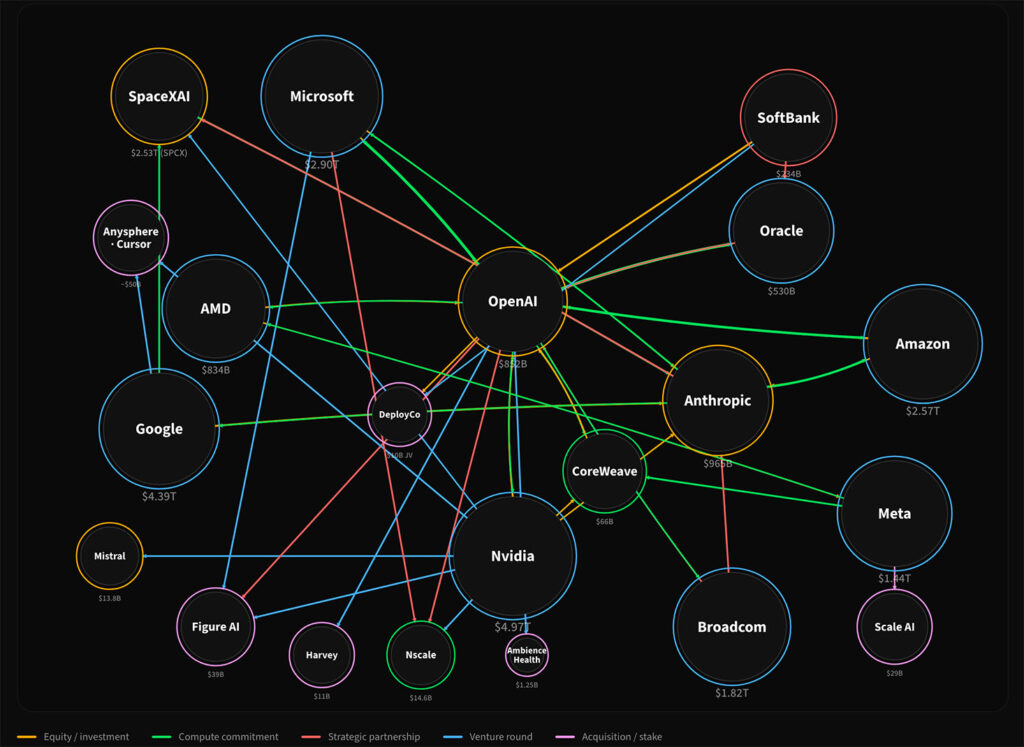
Nvidia plans to invest $100 billion in OpenAI, which in exchange will buy Nvidia chips. AMD struck a similar deal, guaranteeing OpenAI’s ability to buy its chips in exchange for OpenAI becoming one of the company’s biggest shareholders. Finally, Oracle has confirmed a $300 billion deal to supply data center capacity (Smith, 2025).
As you can see, each party is financing the other. This raises questions about the real underlying market demand and whether there’s any actual ROI.
To visualize the investments between these companies, AI Circular Economy illustrates this very well.
Fierce competition
Earlier this year, OpenAI struck a deal with the US military, which sparked an uproar and likely drove some users away (Vallance et al., 2026). Some began shopping around for alternatives, and naturally, many landed on the (former) second-biggest player:
Anthropic.
Anthropic hit particularly hard in early 2026, with stronger-performing models — especially for coding — and a “good guy” positioning during the Super Bowl with its “Can I Get a Six Pack Quickly?” ad.
In response, OpenAI is considering competing on price by lowering the cost of its premium subscriptions (Chin, 2026). But this is a strategy aimed only at regaining market share, since it isn’t sustainable long-term and will only worsen their margin problem.
Ultimately, OpenAI is badly betraying its image as a leader when you look at how frequently it releases new models. Since the release of GPT-5, new models have come out every 2-3 months, sometimes even monthly, whereas before there was roughly one release every 6 months. When you add that their models aren’t the most cost-effective or the smartest on the market, it’s easy to conclude that this innovation race really shows they’re under pressure.
What are the possible solutions?
The option of OpenAI going public (IPO) seems the most obvious to many. Yet such a move isn’t without risk (Lockett, 2026b). The list is long: employee criticism, approval from financial regulators, pressure to perform on financial statements, investor influence, and more. What’s more, the slightest sign of weakness could send OpenAI’s stock into the red, worsening its financial hole even further.
Sources :
Chin, M. (2026, June). OpenAI mulls slashing prices as it competes with Anthropic for users : WSJ. CNBC. https://www.cnbc.com/2026/06/11/openai-mulls-slashing-prices-ahead-of-competition-from-anthropic-wsj.html
Gautam, A. (2026, June). SemiAnalysis: ChatGPT Pro Costs OpenAI $14,000 at Full Use — The Agentic Subsidy Exposed. Abhs.In. https://abhs.in/blog/chatgpt-pro-200-costs-openai-14000-semianalysis-agentic-token-explosion-2026
Lockett, Will (2026a, June). AI Losses Are About To Spiral Out Of Control. Medium. https://wlockett.medium.com/ai-losses-are-about-to-spiral-out-of-control-72a7e8a0fe0d
Lockett, Will (2026b, June). OpenAI Is In A Far Worse Position Than Anyone Thought It Was. Planetearthandbeyond. https://www.planetearthandbeyond.co/p/openai-is-in-a-far-worse-position-d8a
Smith, N. (2025, October). Should we worry about AI’s circular deals? Noahpinion.Blog; Noahpinion. https://www.noahpinion.blog/p/should-we-worry-about-ais-circular
Vallance, C et Cress, L. (2026, March). OpenAI changes deal with US military after backlash. BBC. https://www.bbc.com/news/articles/c3rz1nd0egro
Vedi, S. (2026, March). OpenAI Sora Shutdown: $15M/Day Costs, $2.1M Revenue — The Full Story. Medium. https://medium.com/@shubhamnv2/openai-sora-shutdown-15m-day-costs-2-1m-revenue-the-full-story-088380118243
Kusireddy (2026, Febuary). Google Is Quietly Dismantling Everything OpenAI Built. Medium. https://levelup.gitconnected.com/google-is-quietly-dismantling-everything-openai-built-4edc406f572d